 Ukraine
German Chancellor Friedrich Merz visits Kyiv as Russia launches fresh drone strikes
 Moldova
 Italy
 Colombia
 Cabo Verde
 Austria
 Benin
 Indonesia
 Qatar

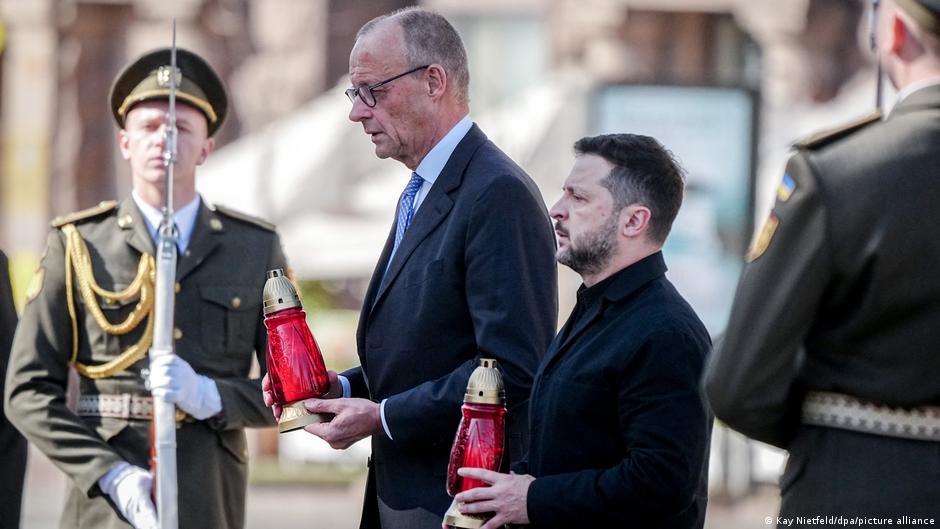
KYIV — German Chancellor Friedrich Merz arrived in the Ukrainian capital on Sunday to meet with President Volodymyr Zelensky, a visit punctuated by the sounds of air raid sirens and explosions as Russian forces launched a fresh drone strike that damaged the Northern Bridge over the Dnipro River.
The visit comes as Moscow intensifies its long-range attacks on Ukrainian infrastructure. During his time in Kyiv, Merz announced a new aid package totaling approximately €1.35 billion ($1.5 billion), split between €1 billion in military support and €350 million designated for the repair and stabilization of Ukraine’s energy grid. In addition to direct funding, Germany and Ukraine finalized an agreement to expand the joint production of interceptor drones and other advanced defense technologies.
Speaking outside the Ukrainian Academy of Sciences, which was recently struck by a Russian drone, the Chancellor issued a direct appeal to the Kremlin. "Mr. Putin, stop this senseless war," Merz said. "We are ready to talk, we are ready to discuss ending this war. But these barbaric attacks against Ukraine must stop."
The international reporting on the visit reflects varying geopolitical priorities. Outlets in Italy and Colombia have focused on the threat the war poses to the stability of the European region, citing Merz’s warning that if the Russian war machine is not halted, it will eventually pose an existential danger beyond Ukraine’s borders. Reporting from Cabo Verde and Benin highlighted the Chancellor’s appeal for diplomatic negotiations alongside his condemnation of the strikes. Meanwhile, outlets in Indonesia and Qatar focused on the logistical reality of the visit, emphasizing the Chancellor's arrival amidst the active air defense sirens and the direct physical damage to Kyiv’s infrastructure.
This visit follows a series of recent engagements aimed at bolstering Ukraine’s domestic military capacity. Throughout 2025 and into 2026, the German government has moved to shift its support toward sustainable, long-term industrial cooperation, including discussions on developing indigenous long-range strike capabilities. These efforts, which have seen Germany commit roughly €11.5 billion ($13.2 billion) in total aid for 2026, coincide with a difficult period for the civilian population. Data monitored by international observers indicates that at least 400 civilians have been killed in Ukraine since the beginning of this year, a 55% increase compared to the same period in 2025.
The damage to the Northern Bridge is part of a broader pattern of Russian targeting of logistics and transit points across the country. As officials in Kyiv coordinate with their German counterparts on the new production agreements, the immediate focus remains on maintaining the functionality of urban infrastructure while responding to the persistent risk of aerial strikes.